Pick up any guitar and you’re holding centuries of innovation, guitar making craftsmanship, and musical evolution in your hands. The instrument that dominates modern music — from blues clubs in Chicago to arena stages around the world — has a history that stretches back thousands of years and spans virtually every culture on the planet. Understanding that history doesn’t just make for interesting conversation; it can also help you appreciate (and evaluate) the guitars that pass through your hands.
Guitar Making Origins: Stringed Instruments in Antiquity
The guitar’s earliest ancestors appeared in the ancient civilizations of Mesopotamia, Egypt, and Central Asia. Instruments like the tanbur and the oud, featuring a resonating body and strings stretched over a neck, date back more than 3,500 years. These weren’t guitars in any modern sense, but they established the fundamental concept that would eventually evolve into the instrument we know today.
The Moors brought the oud to Spain during their conquest of the Iberian Peninsula in the 8th century, where it encountered the European lute tradition. Over the following centuries, these influences blended and evolved. By the 15th century, the vihuela — a flat-backed, guitar-shaped instrument with paired strings — had emerged in Spain and was gaining popularity among both aristocratic and common musicians.
Classical Guitar Making Takes Shape: 1600s–1800s
The instrument we’d recognize as a guitar began taking form in the 1600s, when Spanish builders started producing smaller, more manageable instruments with five courses of strings (pairs of strings tuned in unison). These baroque guitars were lighter and more portable than lutes, which helped drive their popularity among traveling musicians and regular folk who couldn’t afford larger instruments.
The most transformative figure in classical guitar history was Antonio de Torres Jurado, a Spanish luthier working in the mid-1800s. Torres essentially redesigned the guitar from the ground up. He increased the body size, refined the internal bracing pattern using a fan-shaped design, and standardized the string length. His innovations produced an instrument with significantly more volume and tonal richness than anything that had come before. Nearly every acoustic guitar built since owes something to Torres’s design principles.
By the late 1800s, the six-string guitar with nylon (originally gut) strings had become the standard classical instrument, and Spanish guitar music was experiencing a golden age thanks to composers and performers like Francisco Tárrega, who proved the guitar could stand alongside the piano and violin as a serious concert instrument.
Steel Strings and the American Sound: 1880s–1930s
Across the Atlantic, American guitar makers were heading in a different direction. In the 1880s, Christian Frederick Martin (C.F. Martin) and Orville Gibson began experimenting with steel strings, which produced a brighter, louder sound better suited to the American folk, blues, and country traditions emerging at the time.
Martin’s innovations in body design — particularly the Dreadnought shape introduced in the 1930s — created the template for the modern steel-string acoustic guitar. The Dreadnought’s larger body and squared shoulders produced powerful bass response and cutting volume, making it ideal for both solo performance and ensemble playing. The Martin D-28 and D-45 models from this era are now considered some of the most valuable acoustic guitars ever made, with vintage examples commanding six-figure prices.
Gibson, meanwhile, was pushing boundaries with archtop guitars inspired by violin construction. The Gibson L-5, introduced in 1922, featured a carved spruce top and f-holes that gave it a warm, projecting tone favored by jazz musicians. These archtops bridged the gap between acoustic and electric guitar design and remain highly sought-after by collectors.
Guitar Making Meets Electricity: The Electric Revolution: 1930s–1960s
The introduction of electric amplification in the 1930s changed everything. Early experiments with electromagnetic pickups attached to acoustic guitars gave way to purpose-built electric instruments. The race to create the first commercially viable solid-body electric guitar involved several inventors and companies, but two names tower above the rest: Fender and Gibson.
Leo Fender, a radio repairman from Fullerton, California, introduced the Telecaster in 1950 and the Stratocaster in 1954. Neither instrument looked like anything that had come before. Fender’s designs were revolutionary in their simplicity — bolt-on necks, solid slab bodies, and modular construction meant they could be mass-produced and easily repaired. The Stratocaster’s contoured body, tremolo bridge, and three-pickup configuration became the most copied guitar design in history. The Fender archives document how this single instrument shaped decades of popular music.
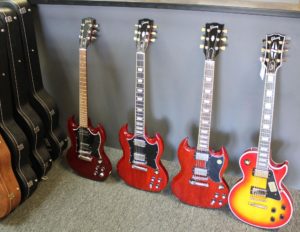
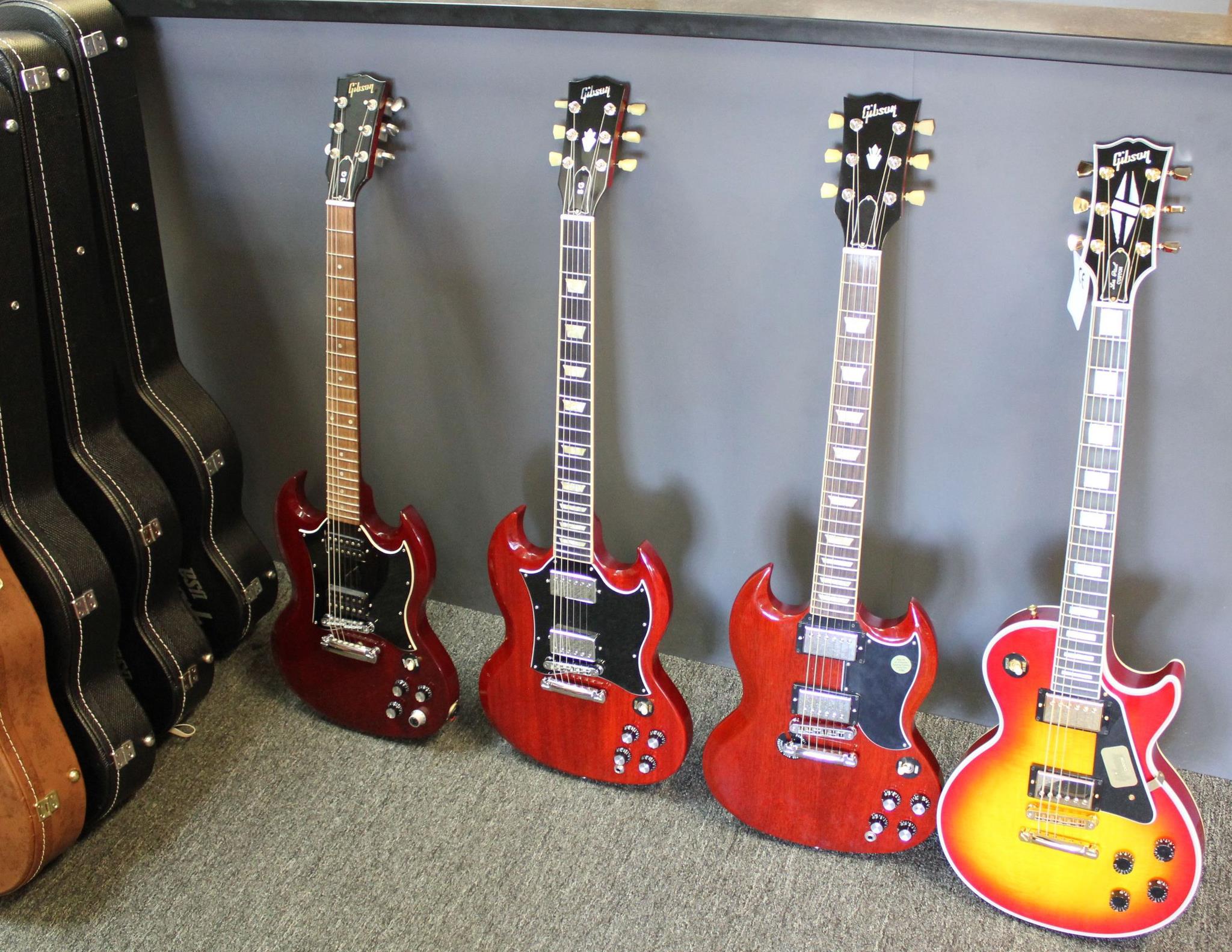
Gibson responded with the Les Paul in 1952, a collaboration with the legendary guitarist and inventor Les Paul himself. Where Fender guitars were bright and snappy, the Les Paul delivered a thick, sustaining tone that became the voice of rock and roll. The 1958–1960 Gibson Les Paul Standards with their distinctive “sunburst” finish are now the most valuable production guitars ever made, with examples selling for $250,000 to over $500,000.
The 1960s saw an explosion of guitar culture. The British Invasion, Jimi Hendrix’s revolutionary playing, and the rise of rock music made the electric guitar the defining instrument of an entire generation. Brands like Rickenbacker, Gretsch, and Guild all contributed iconic designs during this golden era.
Modern Era: Technology Meets Tradition
From the 1970s onward, guitar manufacturing evolved in multiple directions simultaneously. Japanese companies like Yamaha, Ibanez, and Tokai began producing high-quality instruments that challenged American dominance. The “superstrat” era of the 1980s saw builders like Jackson, Charvel, and ESP creating instruments optimized for high-speed playing with flatter fretboards, locking tremolos, and high-output pickups.
The rise of computer-controlled manufacturing (CNC) in the 1990s and 2000s democratized guitar quality. Affordable instruments from companies like Squier, Epiphone, and PRS’s SE line achieved a level of playability and consistency that would have been unthinkable decades earlier. A $500 guitar today plays better than many $2,000 guitars from the 1990s.
Yet at the same time, the vintage and boutique guitar markets have never been stronger. Small independent guitar making luthiers building instruments by hand — using techniques that Torres and Martin would recognize — command wait lists measured in years. And vintage guitars from the 1950s and 1960s continue to appreciate in value, with the most desirable models treated as blue-chip collectibles.
Guitar Making Quality: What Makes a Guitar Valuable?
For anyone looking to buy, sell, or evaluate a guitar, several factors determine value. Brand and model are the starting point — a Gibson, Fender, Martin, or PRS will almost always hold value better than a lesser-known brand. Year of manufacture matters enormously, with guitars from certain “golden eras” commanding significant premiums.
Originality is critical for vintage instruments. Guitars with original finishes, hardware, pickups, and electronics are worth substantially more than modified examples. Even something as simple as a replaced tuning machine or pickguard can reduce a vintage guitar’s value by 20% to 40%.
Condition, playability, and provenance all contribute to the final valuation. A guitar that was owned by a notable musician, appeared on a famous recording, or has documented history will always command a premium over a comparable instrument without that story. If you already own a guitar, our guide on essential practices for electric guitar care can help you protect its value.
Have a guitar you’re curious about? Whether it’s a vintage electric, a classic acoustic, or something you inherited and know nothing about, Lambert Pawn in Whittier, CA, can help you understand what it’s worth. Our team has experience evaluating guitars of all types, from collectible vintage pieces to modern workhorse instruments. Stop by for a free appraisal — you might be surprised at what your guitar is worth.